

Movements
To move stock between warehouses, you use a 'Movement'. A movement is an assignment for the warehouse: you prepare what needs to be moved, collect the products in a container, transport them to the other warehouse and put them away there.
A movement goes through these statuses:
Concept → Collecting → In transit → Putting away → Completed
On this page
Creating a movement
In Picqer, go to Movements > New movement. Choose the warehouse the stock comes from and the warehouse the stock goes to. Optionally add a description, for example what the movement is for, and click Save.
Add the products you want to move. You can do this one by one, or in bulk via an Excel file containing the product code and the amount. While composing the movement, you can see the available stock for each product. You can only move your free stock. Stock reserved for picklists cannot be moved.
Done composing? Click 'Ready to collect'. The movement gets the status Collecting and the warehouse can get started.
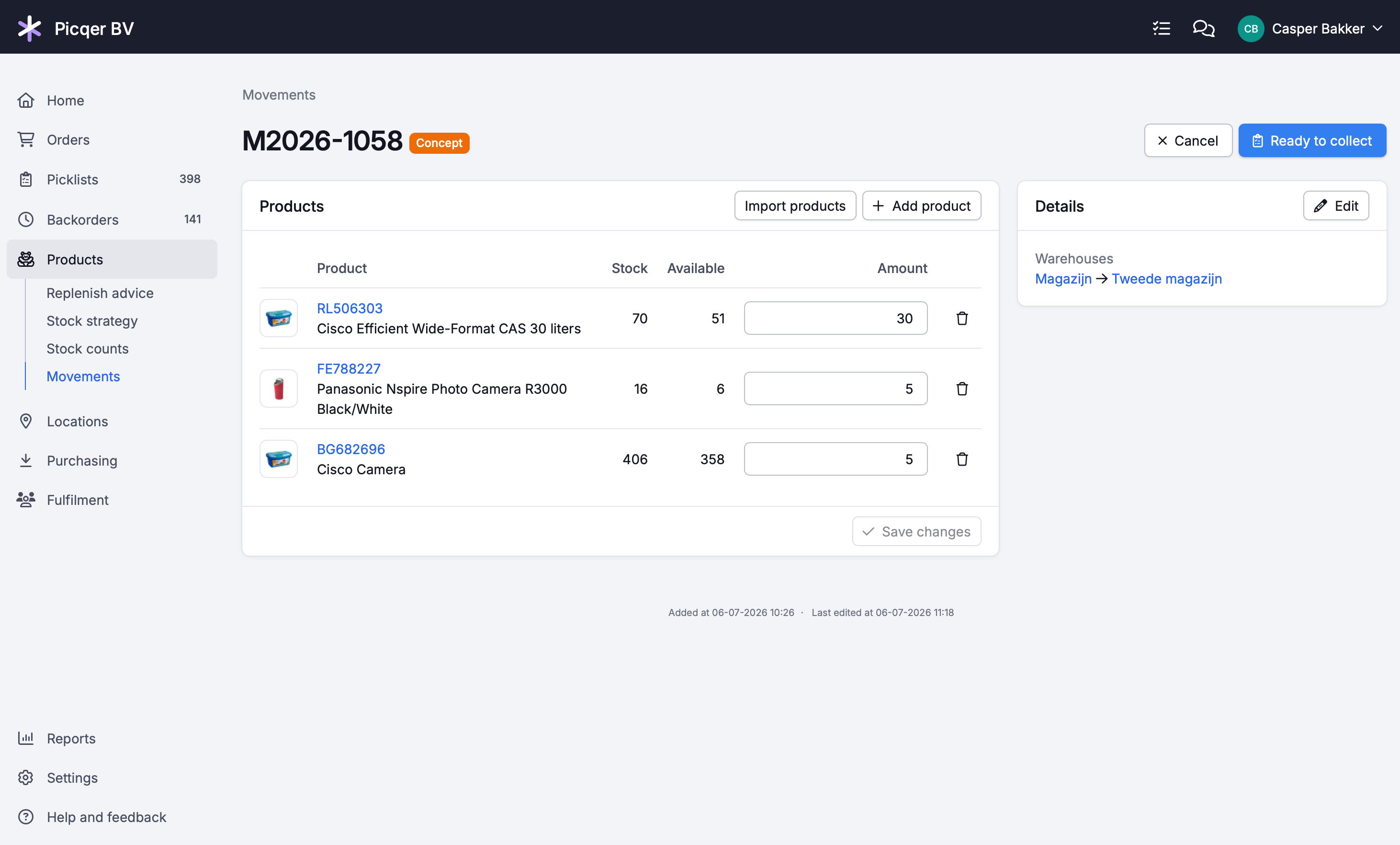 Creating a movement
As long as the movement has the status Concept, you can still change the products and amounts or cancel the movement.
Tip: From the movement advice you create a concept movement with all advised products and amounts in one click.
Collecting
You collect in a container: a crate, cart or pallet you use to transport the stock. First link a container to the movement, for example by scanning its barcode. The container has to be empty and located in the warehouse you are collecting from, and cannot be linked to another movement.
Then collect the products in the container. Picqer suggests a location for each product, but you decide what works in practice:
- You can choose a different location than Picqer suggests.
- You can collect in parts, for example 2 items from location A and 2 items from location B.
- You can collect more or less than the assignment says, for example because a full box is more practical or because there is less stock than requested.
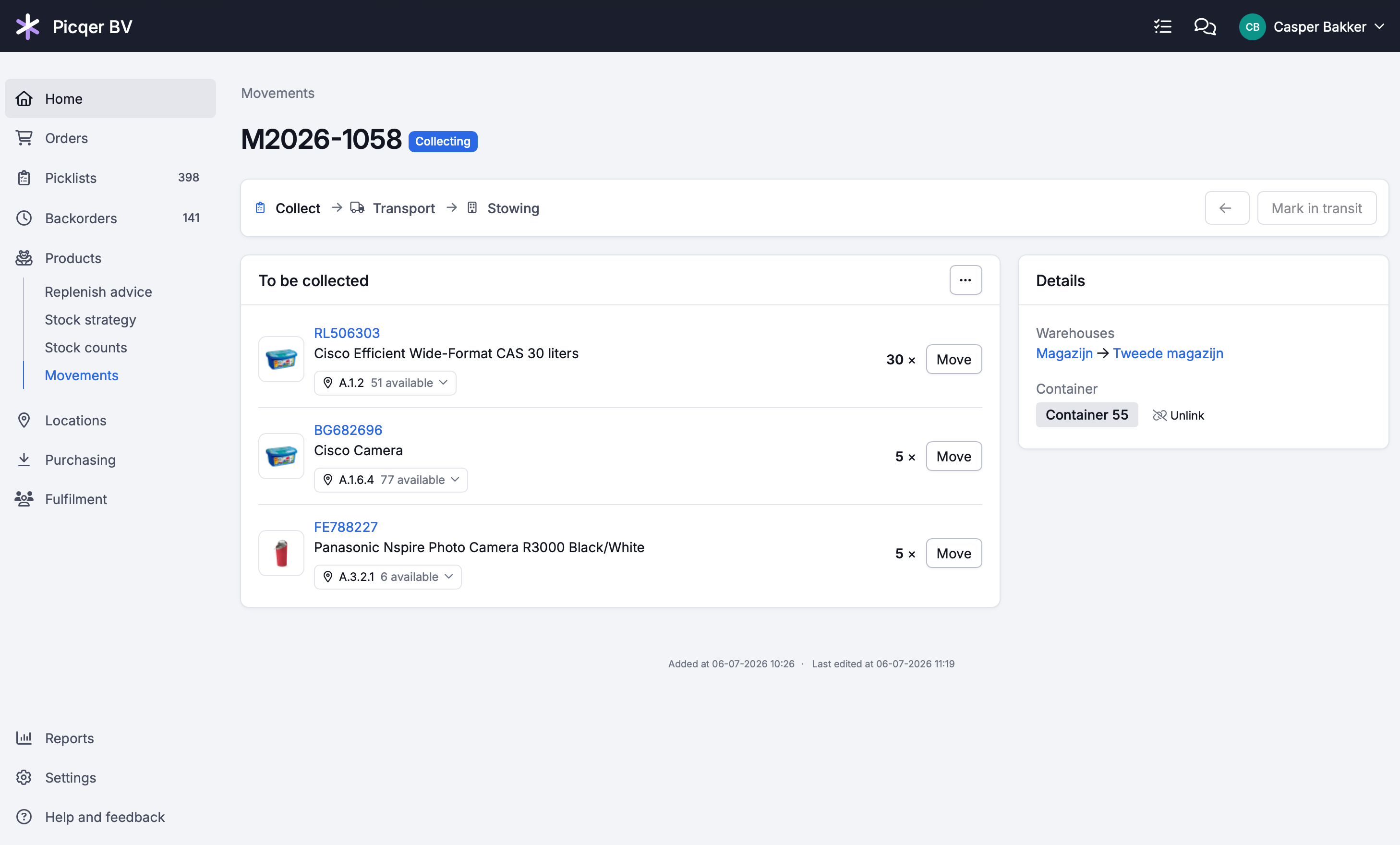 Collecting a movement
Stock in a container is never added to a picklist. This prevents an order picker from looking for a product that is already on its way to the other warehouse.
Collected everything? Click 'Mark as in transit'.
In transit
With the status In transit, the whole team knows what is going on: collecting is done and the stock is on its way to the destination warehouse.
Has the container arrived? Click 'Start putting away'. Picqer moves the container, including its stock, to the destination warehouse.
Putting away
When putting away, you move the products from the container to locations in the destination warehouse. This works just like collecting: Picqer suggests a location for each product, but you can choose a different location or divide a product over multiple locations.
When all products have been put away, you complete the movement. Is there still stock in the container? Then Picqer asks for a confirmation, so you don't accidentally leave products in the container.
After completing
On a completed movement you can see exactly what was moved and between which locations. Products that were not collected are shown separately as 'Not moved'. This way it is always clear afterwards how the movement was executed, even if it deviated from the assignment.
The container is unlinked after completing and can be used again right away for a next movement.
Moving everything at once
Do you mainly use movements administratively, for example for a quarantine warehouse or missing stock? Or have you already done the work outside Picqer? Then you don't have to work product by product. In both Collecting and Putting away, you process all products at once with 'Move all products'.
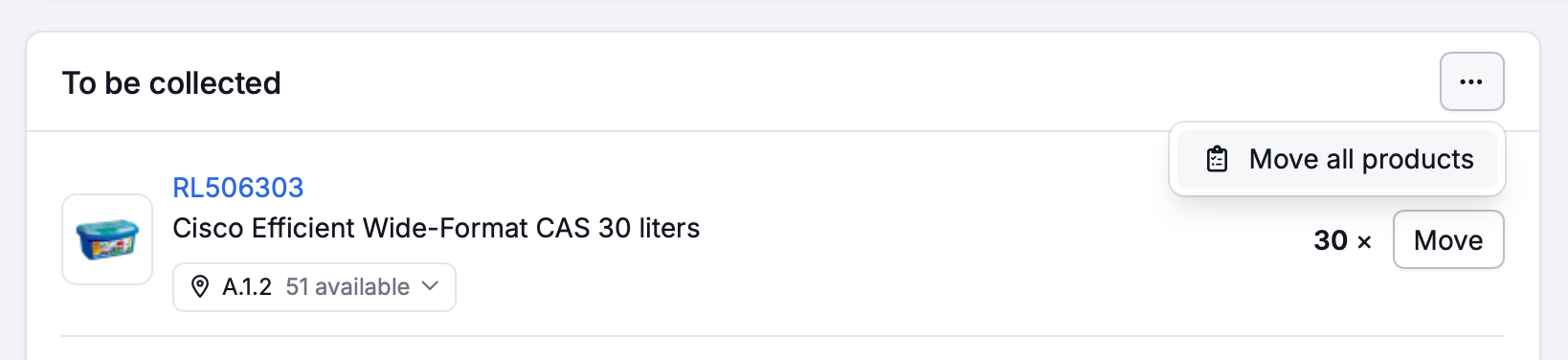 Moving everything at once
How Picqer chooses the locations
Picqer always suggests a location. If you move all products at once, we use the suggested location. You can always adjust this manually. If there is insufficient stock at that location, the remainder stays in the movement and we suggest a new location for that remainder.
We first check whether there is sufficient stock in 'no specific location'. If so, we use that stock. If not, we look at the locations of the product:
- Is there a location with exactly the requested amount? Then we choose this location.
- Next, we look at locations with sufficient stock for the whole movement. Among these, we choose the location with the lowest stock.
- If no location has sufficient stock, we combine multiple locations. We start with the location with the highest stock, to use as few locations as possible.
Movement advice
With the movement advice, Picqer gives you an overview of products you can move from one warehouse to another. The advice is based on the stock strategy of the product in the warehouse you are moving the stock to. With 'Create movement with this advice' you turn the advice into a concept movement right away, which you can still adjust afterwards.
Stock strategy 'Purchase only for backorders'
Does your product have the stock strategy 'Purchase only for backorders'? Then Picqer advises moving this product as soon as one or more backorders are open. For example, if you have 3 backorders for this product in warehouse B, Picqer advises moving 3 items from warehouse A to warehouse B.
Stock strategy 'Keep in stock'
For products with the stock strategy 'Keep in stock', Picqer advises moving the product from warehouse A to warehouse B as soon as the stock in warehouse B reaches or drops below the order level. Picqer then advises moving enough stock to bring it up to the level you have set at 'increase stock to'.