Processing singles batches
60% of all orders in Picqer contain just 1 product row. With a singles batch, you pick these picklists quickly in one go.
Singles batches are part of picklist batches. Picklists with more than 1 product row are picked with a normal batch, or one by one without a batch.
What is a single picklist?
A picklist is a single when it has only 1 product row, so you only need to grab 1 product for it. A single can contain several pieces of the same product, but not different products.
Because each picklist holds just 1 product, you can put all products in 1 container or cart while picking. At the packing table, you take any product from the cart and Picqer knows which picklist it belongs to. You don't have to pick in a set order or gather several products for one order. That's why you don't use picking containers in a singles batch.
Lot numbers and expiration dates
Do you track lot numbers or expiration dates for a product? Then a picklist with that product only goes into a singles batch if the product is picked from 1 stock location. If it's picked from several locations, the picklist doesn't go into a singles batch.
Within a singles batch, all picklists for the same product are picked from the same location, and so from the same lot number. Picqer leaves picklists where the product comes from a different location out of that batch.
Processing a singles batch
You process a singles batch in these steps.
Create a batch via Create batch. Choose a preset there, or click 'Manual'.
Open the batch in the Picqer app. Prefer to work on paper? Print the batch PDF from the computer instead.
Collect the products in your warehouse. Scan or tap each product in the app so you can see how far along you are.
Once you've picked all products, go to the packing table and open the batch on the computer. You see the products in the batch, with the picklists it contains at the bottom.
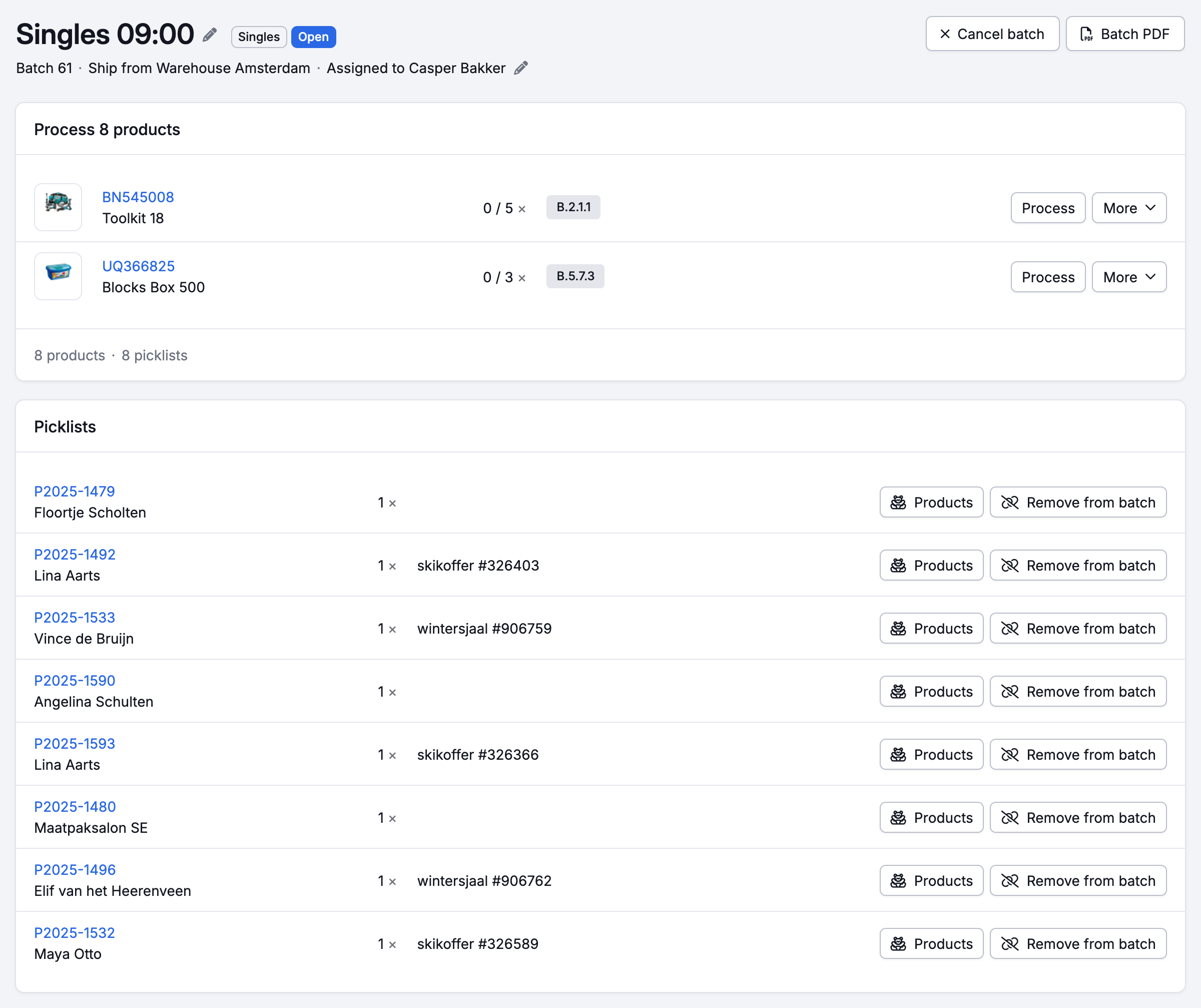
Take any product and scan its barcode, or click 'Process' next to the product. You see the picklist for this product and create the shipment right away.
Pack the product, stick the shipping label on the box and scan the next product.
Bulk processing
Got lots of picklists for the same product? Then bulk processing is faster. It handles all picklists with the same product and the same number of pieces in one go. For each picklist in the batch with that product, Picqer creates the shipment and closes the picklist. Since every box holds the same thing, it doesn't matter which label goes on which box.
Open the singles batch.
Click 'More' next to the product and choose 'Process in bulk'. When you scan a product that still has 3 or more open picklists, 'Process in bulk' also shows below the picklist.
Under 'Which picklists would you like to process in bulk?', choose the number of pieces. One run only processes picklists with the same number of pieces.
Under 'How many picklists would you like to process in bulk?', enter how many picklists to process. The maximum is 100 at a time.
Click 'Start bulk processing'.
To use bulk processing, you need the user right 'Mark products as picked manually' or 'Mark all products as picked manually'.
Shipping profile and packaging
Picqer uses the shipping profile that is preselected on the picklist. If no shipping profile is preselected, Picqer uses the default shipping profile. So check before you start that this is the shipping profile you want.
As packaging, Picqer registers the advised packaging. If no packaging is advised, Picqer doesn't register any.