
A look inside the warehouse of ZO in Lekkerkerk
The first thing you notice when you arrive is the truck with large lettering: "Never clean again". A bold statement for a webshop selling cleaning products. But once we sit down with the team at the kitchen table, it makes perfect sense.
The idea behind ZO: cleaning should be a routine, not a chore. It's about staying clean rather than getting clean. No buckets, no soapy water, no scrubbing. All you need is a sprayer within reach, so you can tackle things the moment they need it.
The colorful sprayers, cloths, and refill pouches stand in neat rows throughout the warehouse. At the front, orders are picked and starter kits are packed. At the back, refill pouches are filled. The atmosphere is relaxed and friendly. And the place is spotless.
We sit down with co-founder Bert Groen, right in the middle of the warehouse. He talks passionately about ZO, the move to the new space, and how they work today.
Changelog
Changelog: an updated fulfilment portal with purchase advice and more
As you may have noticed, we gave the fulfilment portal a major update last month. In this changelog, we’ll walk you through what’s new, and more.
An updated fulfilment portal
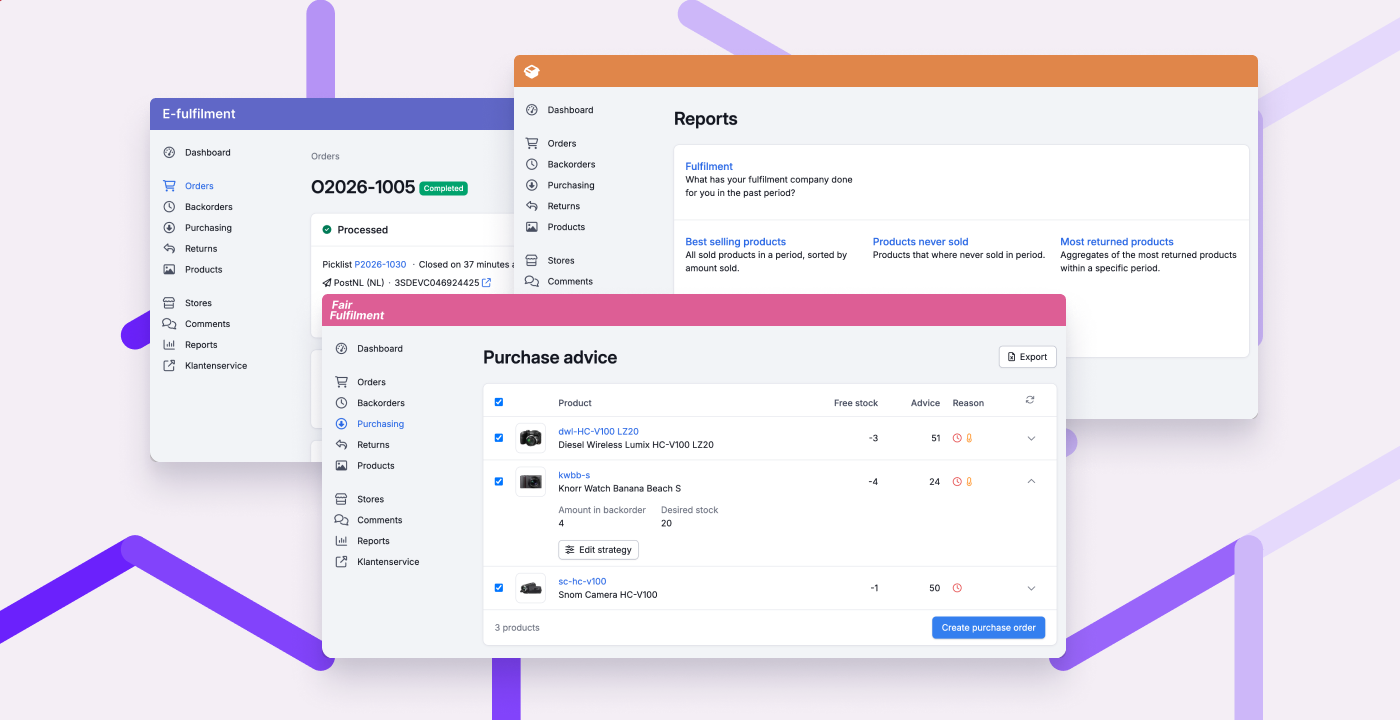
Your fulfilment customers now get a clearer overview, better insight, and more ways to help themselves. That gives you more time to focus on the warehouse. The updated portal has a more modern look, works better on mobile, and can be branded with your own colour and logo.
The biggest news: dedicated purchase advice for your fulfilment customers. They see at a glance what to purchase, and turn it into a purchase order with a single click. The advice is based on open backorders and a stock strategy they can set per product. Read more about how it works
The updated portal includes a lot more:
- Orders: your fulfilment customers can now find and create orders more easily, and see at a glance what stage an order is in.
- Cancel products: your fulfilment customers can now cancel products on an order themselves, as long as they haven't been picked yet.
- Partial deliveries: you can now choose per fulfilment customer whether they can create a picklist themselves when part of an order is in stock.
- Product management: your fulfilment customers can now (de)activate and delete products themselves, if you enabled product management for them.
- Store actions: your fulfilment customers can now import products themselves, send stock to the store, and run a extended order import, provided this is also enabled in the store settings.
- Address book: your fulfilment customers can now edit and delete addresses more easily.
- Reports: your fulfilment customers can now request reports themselves, such as the fulfilment report (showing what has been done for them), stock at a specific moment, and which products sell best or do not sell at all.
- Stock per warehouse: in the fulfilment portal settings, you can now let your fulfilment customers see stock per warehouse.
Over the coming weeks, we’ll keep improving the fulfilment portal. Got feedback or questions? Let us know.
Other improvements
- New integration: Rewize
- When processing returns, you can now choose a location per product, just like with receipts.
- The batch PDF now makes it clearer which products don't have a location.
- You can now require colleagues to scan the destination location whenever they move stock on mobile.
Fixed
- VAT on shipping costs is now processed correctly when importing Shopify orders.
- The container page is fast again, even for containers with many products.
- The overview of picklists to invoice is fast again.
- The selected warehouse is now also used for quick stock changes.
- The supplier name is now always shown correctly on purchase orders, even if you entered it manually.
- Scanning a location on mobile no longer accidentally triggers a product search.
Join us on May 12 for the Picqer Session and learn about building with our API

You have Picqer running smoothly. But maybe you want more: a connection with another system, a specific dashboard, or a piece of automation that isn't standard. All of that is possible with the Picqer API. The question is: how do you go about it?
On Tuesday evening, May 12, Jeroen (CTO of Visdeal) and Gerben Peters (owner of eConcepts) will show what they have built themselves with the Picqer API. Afterwards, we'll split into small roundtables to discuss each other's situations.
Please note: This Picqer Session will be held in Dutch.
New integration: Rewize

A new integration is available: Rewize. This is an AI-powered solution for demand and purchasing forecasting. When you connect Rewize to Picqer, inventory, product, and sales data is pulled from Picqer and converted into concrete purchasing advice in Rewize.
Rewize links the data from Picqer to the sales data from all your channels, such as Shopify, Bol, Amazon, Decathlon, and more. Using this data, AI forecasts how many units of each product you will sell per channel and per week, including seasonal patterns and growth trends.
Based on this, you receive advice per SKU: what to order, how much, and when. Convert the purchasing advice into a purchase order with a single click, which is immediately available in Picqer for your supplier. Make a change in Rewize or Picqer? It syncs instantly. No duplicate work or mismatched quantities between systems.
Run an efficient warehouse: fewer exceptions, more flow

A well-organised warehouse is one thing. Running it smoothly every day is another.
A large purchase order comes in, a return flow you hadn't anticipated, or the person who knows everything calls in sick. You're immediately an hour behind.
In practice, the problem isn't the delivery, the returned product, or your colleague. The problem is that your warehouse lacks good processes, which makes it impossible to get into a nice flow together.
What we often notice in well-run warehouses is that employees are relaxed. You can see that their work is routine. Everyone has the right knowledge and tools to do the job well.
This article is about how to run your warehouse efficiently, so your team runs smoothly too. We help hundreds of webshops with warehouse software, and we see every day what works and what doesn't. These three tips make the biggest difference.
Looking for an older article? Browse the full blog archive with all articles.