
Changelog
We continuously improve Picqer. Every few weeks, we publish a changelog with the latest improvements.
Stay on top of expiration dates, add products to orders, and more
Earlier this month, we launched traceability, which lets you track expiration dates and lot numbers. We’re now building on that to help you ship stock before it expires and quickly find the information you need during a recall. You can also easily add products to an order. Here’s what’s changed.
Stay on top of expiration dates and lot numbers
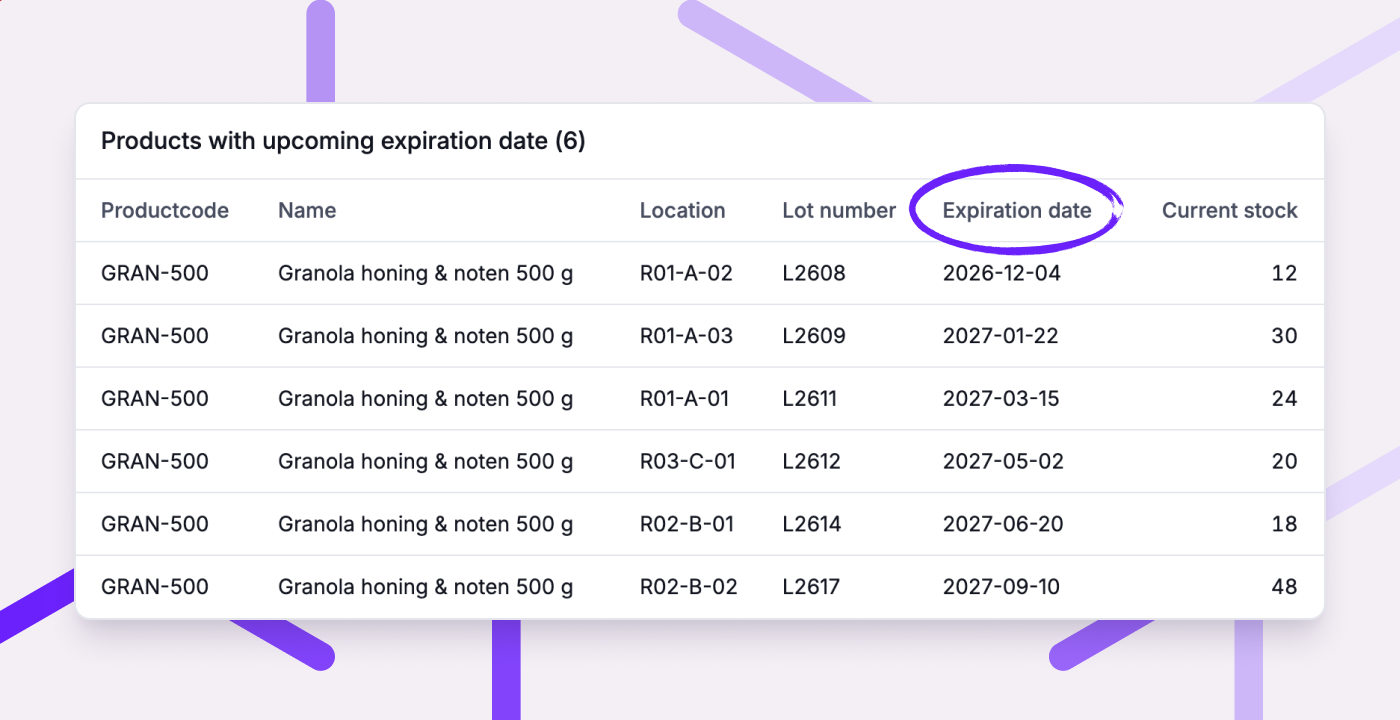
If you have several lots of the same product in stock, you want to ship those with the earliest expiration dates before they expire. And if a supplier recalls a lot, you need to find out quickly where it went. Picqer now helps you with both.
Expiration dates now help determine where to pick. When creating a picklist, Picqer now selects the location with the earliest expiration date. This is called FEFO: first expiry, first out. This means you ship the lot with the earliest expiration date first.
Spot stock that's about to expire. The new 'Products with upcoming expiration date' report lists stock that will expire soon or has already expired. This gives you time to sell it before it expires, or remove expired stock from your warehouse. Your fulfilment customers can view the report in their portal too.
Quickly find out which customers received a lot. During a recall, you no longer need to check individual picklists. From the product page, you can see which customers received a lot and where you still have stock from it. That tells you who to contact and which stock to remove.
Learn more about traceability and FEFO in our guide to lot numbers and expiration dates.
Add products to an order
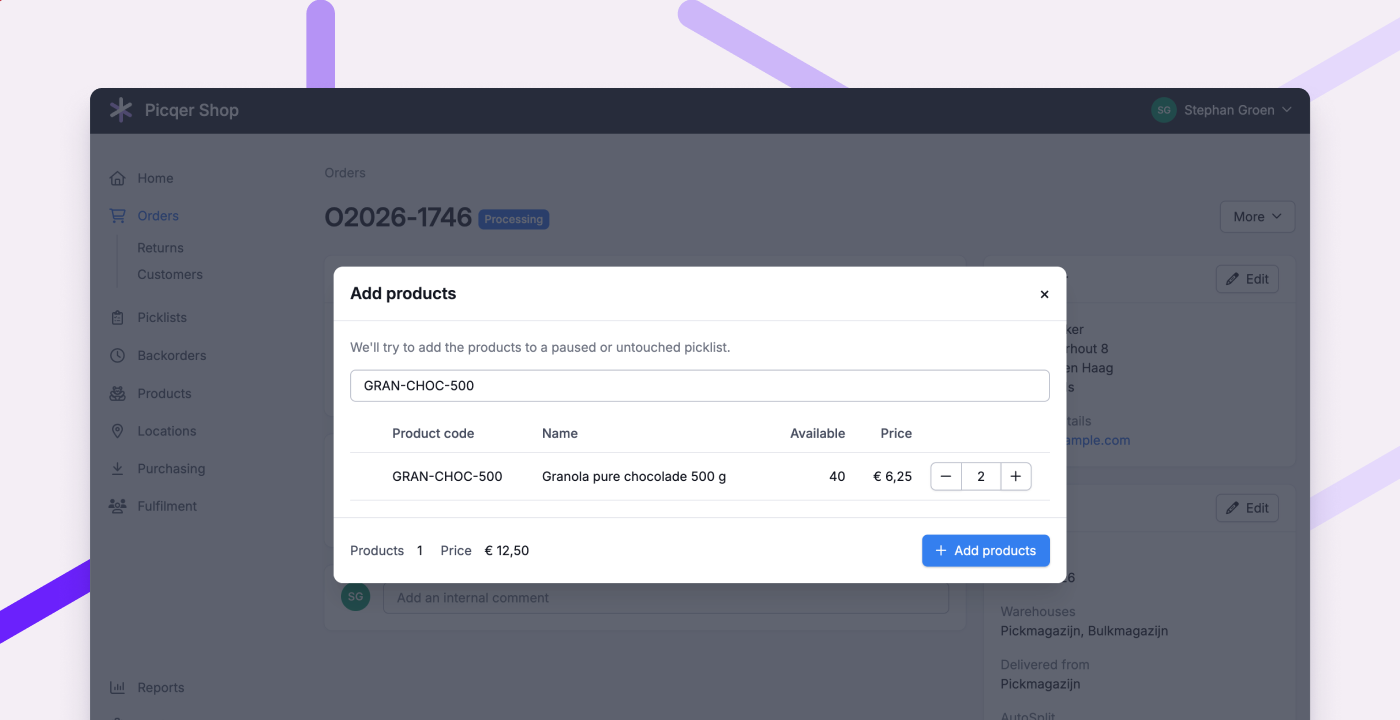
You can now easily add products to an order. Did a customer call or email with a last-minute addition, or want a different product? Add it straight from the order page, without resetting the order to concept.
- If picking hasn't started, the products are added to the open picklist.
- Already started picking? Pause the picklist first, otherwise Picqer creates a new one.
- Out-of-stock products go on backorder.
- Your fulfilment customers can do this themselves in the portal, as long as picking hasn't started.
Other improvements
- When a customer chooses pickup in Shopify, Picqer now marks the order as 'ready for pickup' when you close the picklist. Learn more about pickup orders
- Picqer now separates Dutch addresses into street name, house number and suffix before sending them to PostNL. This ensures that even tricky addresses, such as '2e Dorpsstraat 13b', appear correctly on shipping labels.
- Your fulfilment customers can now edit product descriptions themselves in the portal. They can also see which orders have been partially processed.
- You can now filter movement advice by fulfilment customer.
- If you sell virtual compositions from multiple warehouses, your stock levels are now more accurate. Picqer counts the components across all warehouses.
- You can now show the components of virtual compositions on packinglists, including product fields and lot details. This helps your customers check the contents of a set.
- Order pages load faster, especially for orders with lots of picklists or comments.
- You can now use customer remarks as a condition in order and picklist rules.
- The return history now shows who created the return, and the 'Returns processed' report shows who completed it.
Fixed
- Shopify orders with no billing name now import correctly, using the delivery name instead.
- Picklists and their PDFs now show the correct component quantities for virtual compositions, including nested compositions.
- Products on closed picklists no longer appear as 'to pick' in a batch.
- You can once again link locations in the app for products that have many locations.
- The correct free stock is now shown when moving stock to another warehouse.
- You can once again reverse the production of compositions with their own stock by entering a negative quantity.
- Products with unlimited stock are back in the 'Warehouse sales' report.
- Safari's password suggestions no longer cause the shipping profile menu to close.
Traceability and more
Last week we saw many of you at the Meet & Grill. We presented three new features there: traceability, an MCP server and a CSS assistant. All three are now live. In this changelog you can read all about them, and what else has been improved and fixed.
Traceability
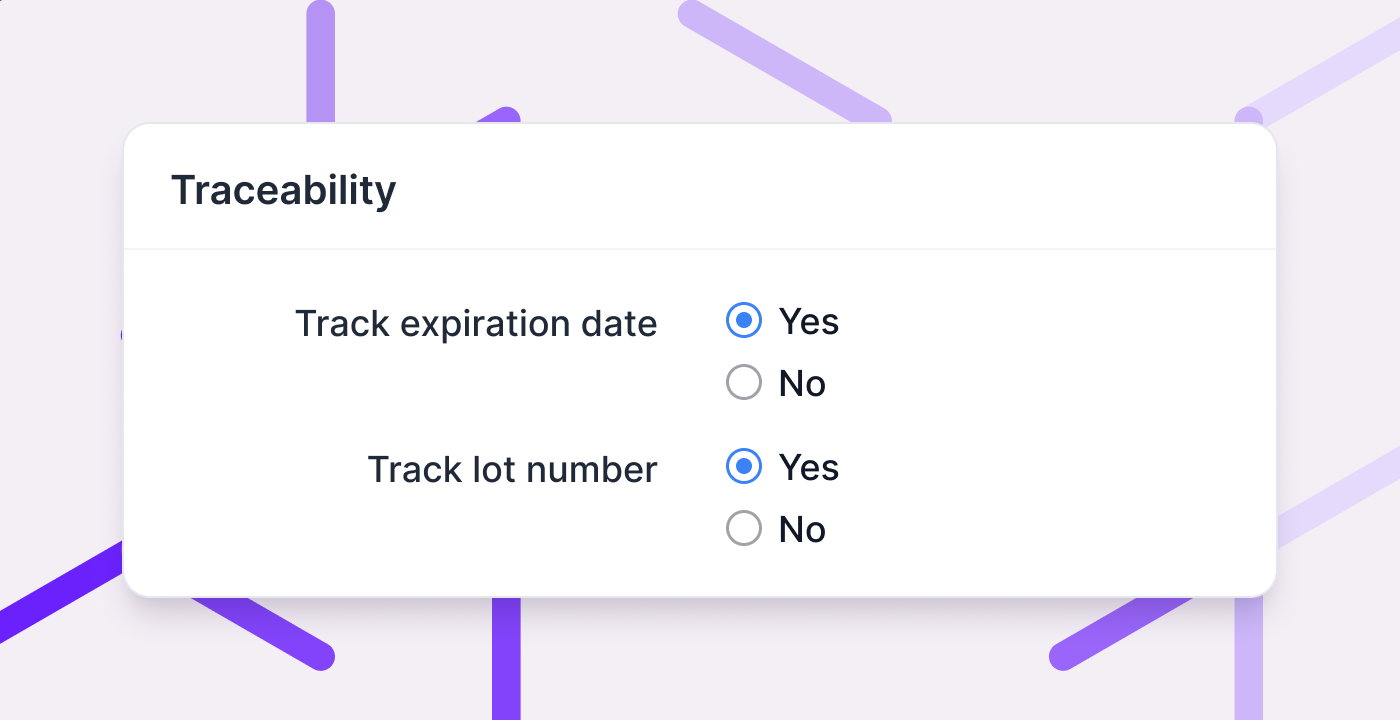
Do you sell products with an expiration date or a lot number? Then you need to know which lot is where, and which customer received it. With traceability you keep track of that in Picqer.
Switch it on in Settings and choose per product what you record: an expiration date, a lot number, or both. You enter the details once, when you receive the goods. After that they follow the stock by themselves, through moves and picks, onto the picklist and the packinglist.
Picqer keeps that record long after the stock has left your warehouse. So when a supplier recalls a batch, you can look up who received it.
Read the guide to lot numbers and expiration dates, or get started right away with setting up traceability.
The next step is FEFO: first expiry, first out. Picqer will then send you to the location with the earliest expiration date, so older stock does not get left behind.
MCP server: connecting Picqer to an AI assistant
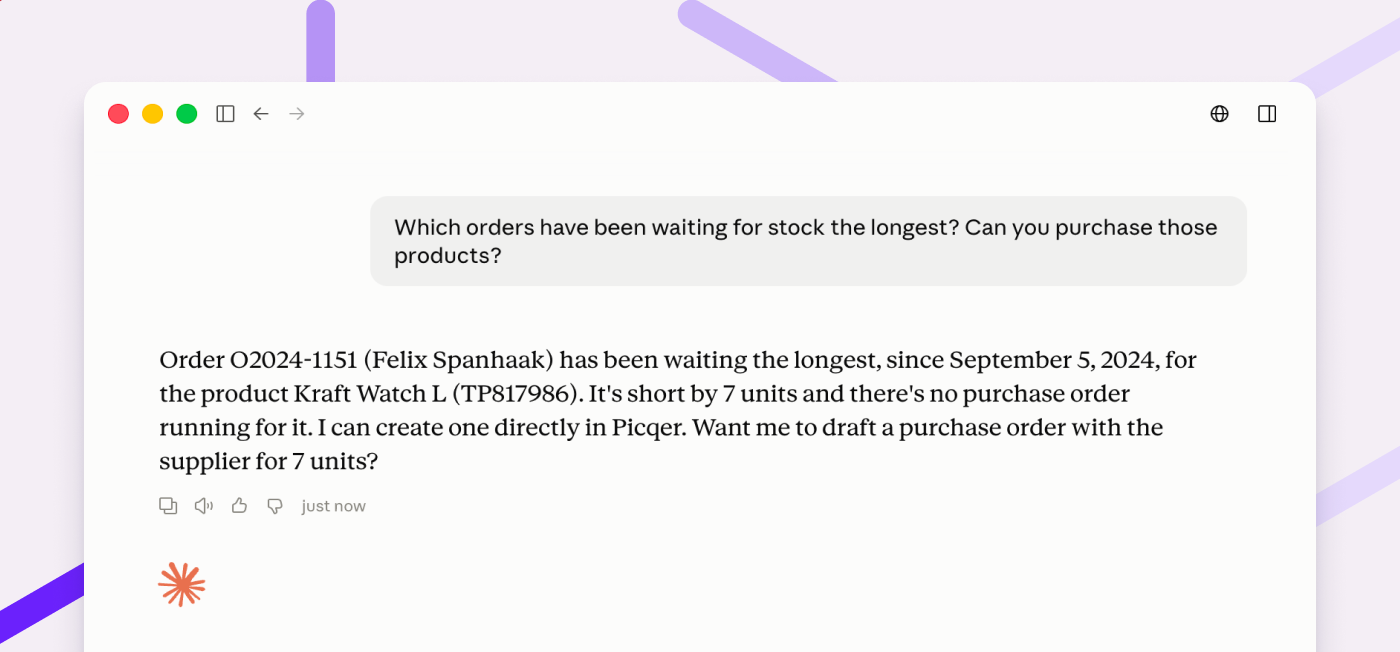
You can now connect Picqer to an AI assistant, such as Claude or ChatGPT. Ask a question or give an instruction in plain language, and the assistant carries it out in Picqer. Useful for the kind of work that would otherwise take you through several screens.
You decide what the assistant may do: read only, or take action as well. Personal data can stay out of it entirely. And processing orders, closing picklists or creating shipments is something an assistant can never do.
The MCP server is still in beta. We would love to hear how you get on with it.
A CSS assistant for your templates
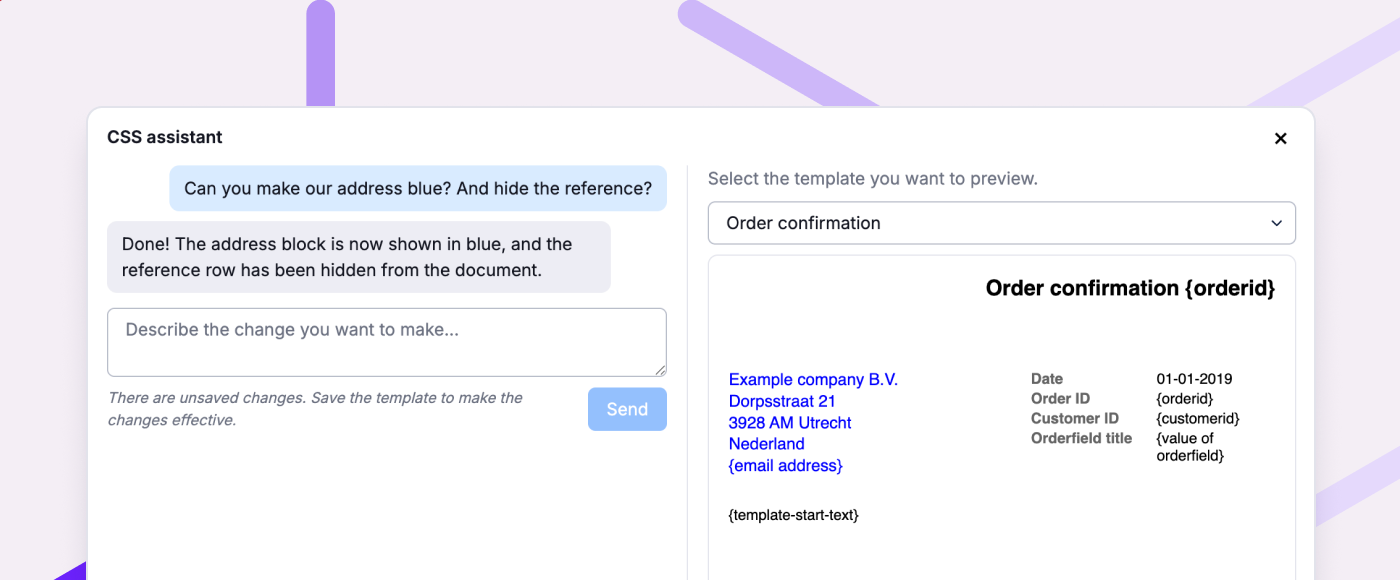
Your templates for picklists, packinglists and invoices are styled with CSS. You no longer have to write it yourself. Tell the CSS assistant in plain language what you want to change, a bigger logo say, or the header in your brand colour. The preview next to it shows the result straight away.
You will find the assistant under the 'Custom CSS' field with your templates.
Other improvements
- Several settings now have their own rights. That way you can delegate management without making someone an admin.
- Sendcloud pickup points now also come in from Shopify Advanced, next to Shopify Plus.
- On a return you add all products from the order as replacement products in one click. You can also prioritise backorders for replacement products.
- You now copy product codes and barcodes in one click from the product page and the product popup.
- In your rules for orders you can now also use product dimensions as a condition.
- When a fulfilment customer cancels an order, you now clearly see that in the order log.
Fixed
- New tags are available in filters straight away. You no longer have to wait up to an hour.
- Orders from the portal use the right warehouses again.
Move stock between warehouses step by step, and more
Over the past month we've revamped Movements, the way you move stock between warehouses. Where that used to happen in a single click, it's now a task you carry out step by step, on web and in the app. In this changelog, you can read everything that's changed.
Revamped: Movements
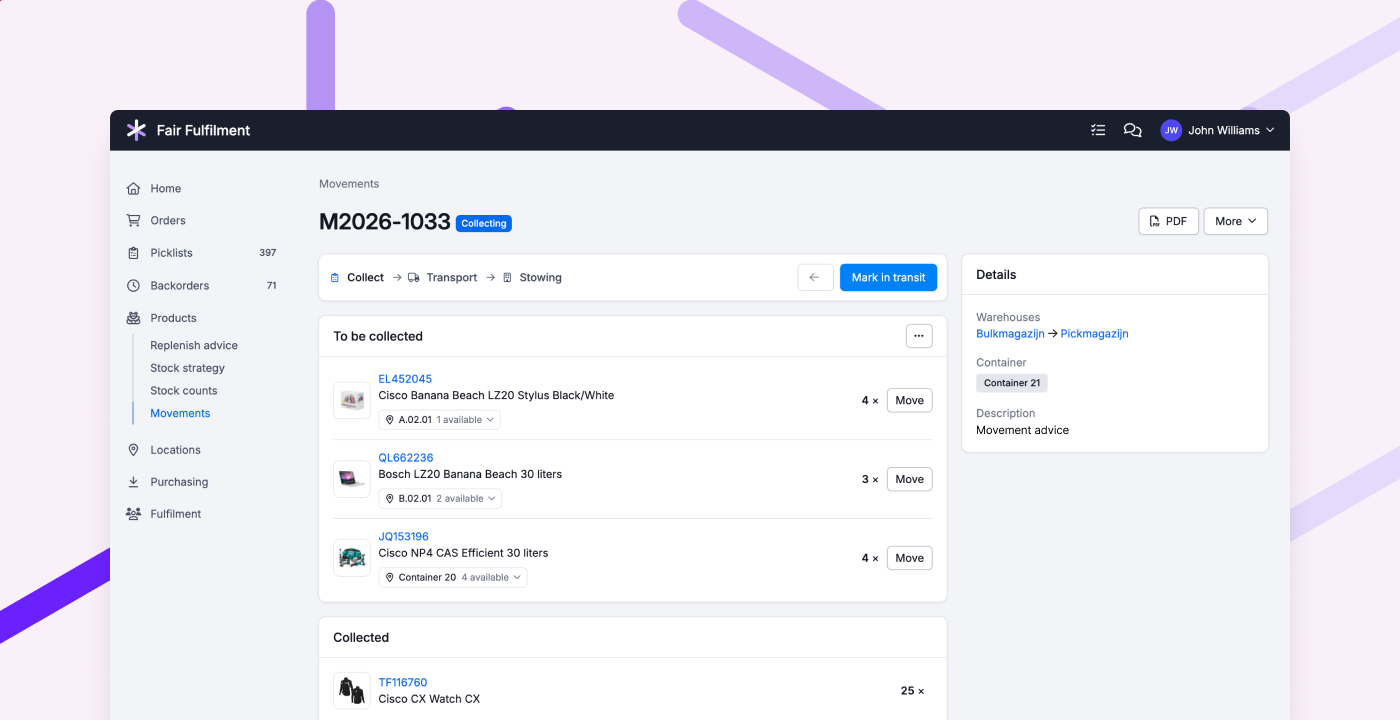
A movement in Picqer now follows the steps in the warehouse: you collect the products in a container, bring it to the other warehouse, and stow the products there. Each step has its own status, so everyone knows where the stock is and what still needs to happen.
Collecting and stowing happen in the app, sorted by picking route through your warehouse. For each product, Picqer suggests a location. You adjust it where needed, and the amount too. For example, if you'd rather take a whole pallet. At the end, you see exactly what was moved, between which locations, and where it differed from the plan.
We'd love to hear what you think of the new Movements. The old way is still available for now, but will disappear soon.
Other improvements
- When creating a batch, you can now also select multiple fulfilment customers, and filter by packaging advice.
- When counting stock, you can now add locations based on the products stored on them, filtered by fulfilment customer, supplier, or tag.
- When importing orders from WooCommerce, we now support more formats for the preferred delivery date.
- In the fulfilment portal, backorders are now grouped by order, just like in Picqer.
- When manually adding picklists to a batch, you now also see the batch title.
- When importing customers, you can now also update the delivery and billing address, including for existing customers.
Fixed
- When processing returns, you no longer have to choose a location for products with unlimited stock.
- Pickup points from QLS's new Shopify checkout are now imported correctly.
Fine-tune your batches and more
In the previous changelog, we made it easier to create batches using presets. We're building on that: you can now fine-tune your batches even further, with new filters and options. In this changelog, you can read everything that's changed.
Fine-tune your batches
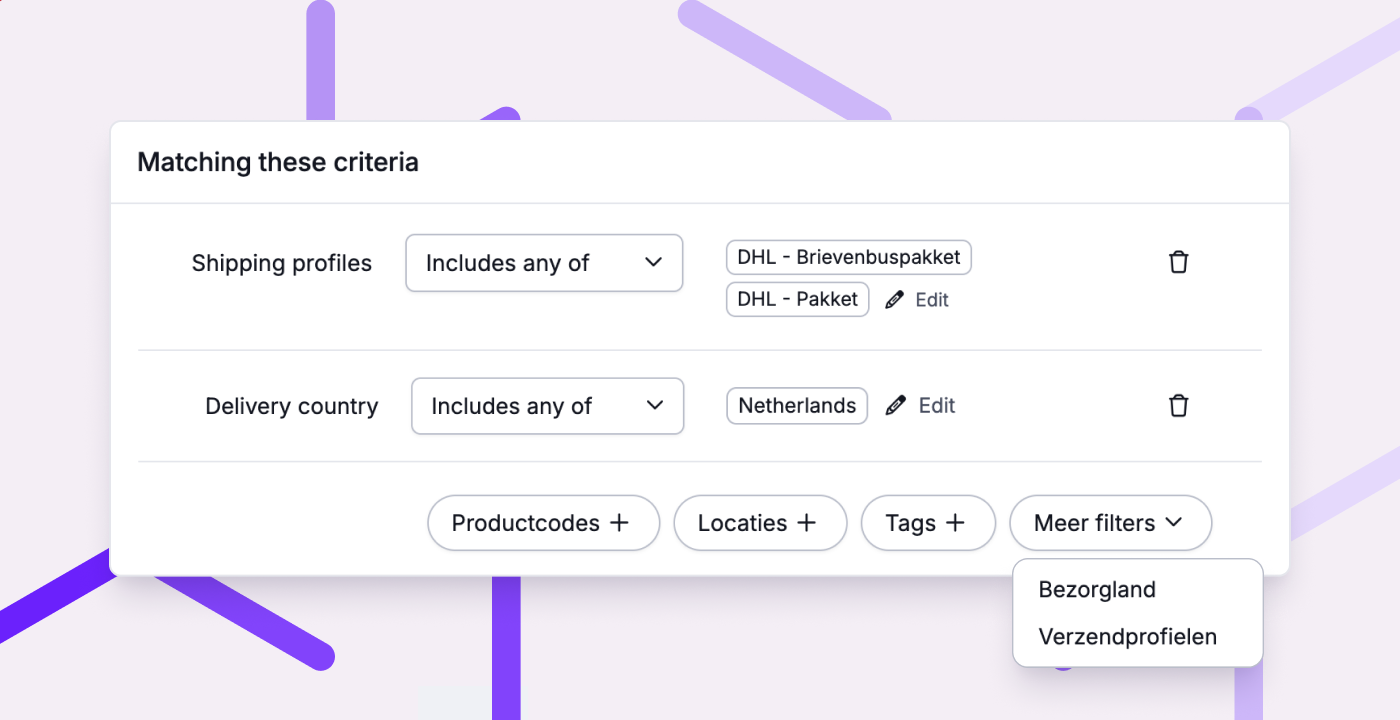
The more varied your orders, the more control you want over which picklists end up in a batch. That's why you now put your batches together more precisely, with new filters, like delivery country and shipping profile, and new options per filter. That means you no longer need to set up your own rules and tags to get to the same selection.
A few of the new possibilities:
- Filter by delivery country, handy for prioritising domestic orders so you meet your delivery promise: order today, delivered tomorrow.
- Filter by shipping profile, handy for meeting a carrier's cut-off time.
- Exclude products or locations, handy for handling unusual items or bulk locations separately.
- Exclude tags, handy for keeping picklists with, say, gift wrapping out of the batch.
Other improvements
- Updates about Picqer, like this changelog, now live under Help & feedback in the sidebar.
- The container page now shows the products you recently moved out of it, at the bottom, so a quick mistake is easy to undo.
- Linking a location from the product page is now easier.
- In the fulfilment portal, the 'Stock at a specific moment' report now also shows cost price, price, and type. That lets your fulfilment customers work out their stock and sales value themselves, without extra exports.
- The order export now also includes the preferred delivery date.
- On manual shipping labels, the sender address now sits on one line and the sender country is shown, as carriers recommend.
Fixed
- Shipments to Madeira, the Azores, the Canary Islands, and Ireland now include the required customs information, so they're created correctly.
- Bundle products from Shopware 6 are now ignored, so you only ship the individual components.
- Emojis in (customer) remarks no longer cut off your text. The emoji itself is dropped, but the rest stays intact.
Create batches faster, process backorders automatically, and more
In your warehouse, every small step counts. That’s why we’ve made it easier to create batches with presets, and backorders can now be processed automatically when stock becomes available. In this changelog, you’ll read what has changed.
Create batches faster with presets
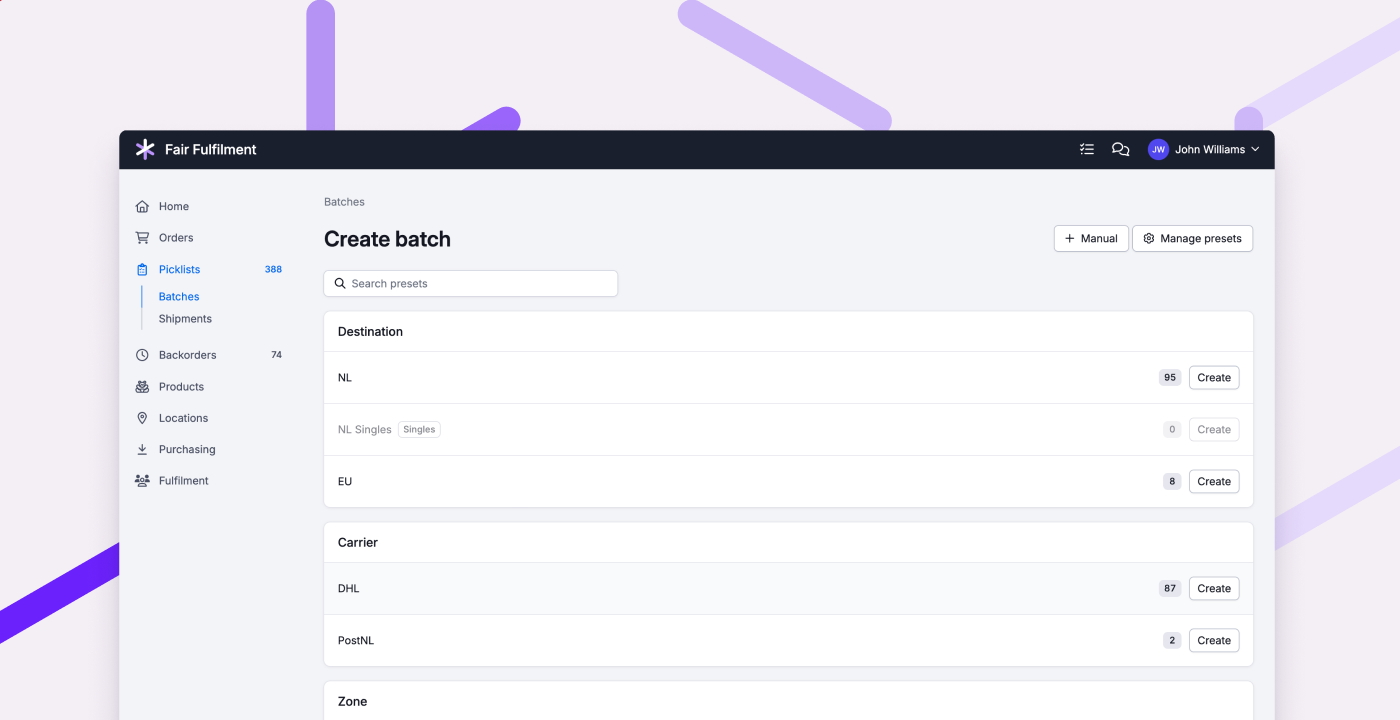
Batches save a lot of time when picking. With a batch preset, you set the right filters once, so you don't have to think about them every time. We've made that even easier: instead of starting in the form, you now pick the preset you want right away, just like you're already used to in the Picqer app. So you create a batch in one click and can start picking immediately.
Got a lot of presets? Then you'll want to find the right one quickly. That's why you can now group and sort presets, and hide them when you don't need them for a while. So your list stays organised.
The batch overview is also clearer now. Previously, open, completed, and cancelled batches were mixed together. Now you see at a glance which ones are still open, and you can filter to find what you need. You can also give a batch its own name, and see which preset was used.
Process backorders automatically
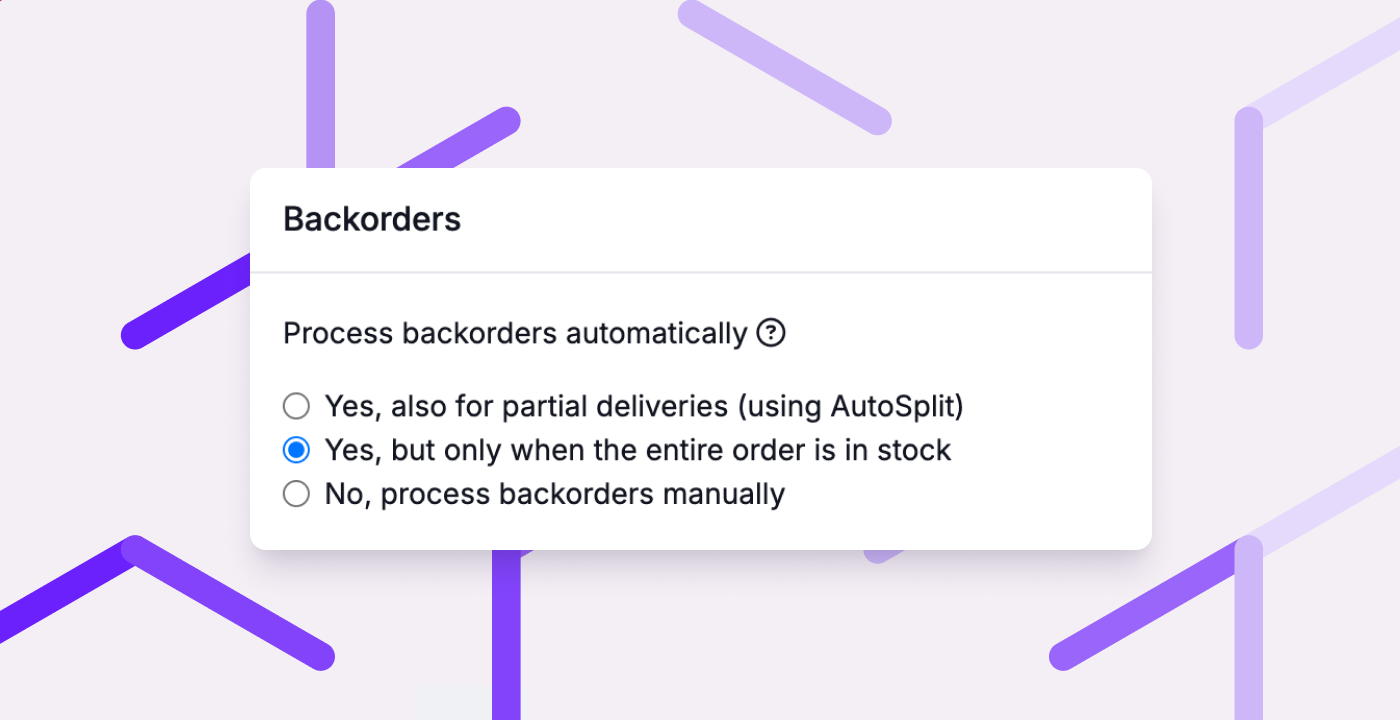
When an order is in backorder, you want it to ship as soon as possible. That's why backorders can now be processed automatically: as soon as the order is partially or fully in stock, Picqer creates a picklist. That way, backorders need less manual attention, and orders ship out faster.
Prefer to stay in control? We’ve improved manual processing too. You can now filter by warehouse, supplier, or fulfilment customer, see in advance how many picklists that will create, and set a limit.
Other improvements
- When pausing a picklist, you can now choose whether to pause just the picklist or the entire order. Useful when the issue needs to be resolved by customer service or your fulfilment customer.
- In the portal, your fulfilment customers can now set up a notification for paused orders.
- New orders from Bol now appear in Picqer sooner.
- VVB orders with Ampère are now automatically snoozed until 3:00 PM the day before handover, just like DHL Same Day.
Fixed
- Pickup points on MyParcel shipments from WooCommerce are imported into Picqer again.
- Sendcloud shipments to Northern Cyprus are created correctly again.
- Bundle products are displayed correctly on a picklist again.
- You can again type an email address in a comment without any issues.